
Solutions / AI development

Turn the way you work into software that works for you.

Practical AI-assisted development for business workflows, internal tools, and new platform ideas.

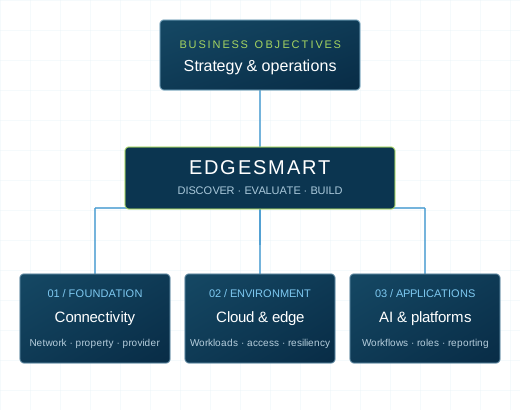
EdgeSmart connects business strategy with connectivity, infrastructure, AI and platforms
A connected view of the technology that runs your business.
CapabilitiesExplore
Detailed service capabilities

AI-assisted development with business purpose

Connect discovery, workflow design, software development, and validation around a specific operational need.

Select a capability to explore the approach and potential deliverables.

01

Business workflow discovery

Map tasks, handoffs, decisions, records, and exceptions. Identify where manual effort or inconsistent information creates friction. Define the user experience and acceptance criteria before expanding the build.

Potential planning outputs

Process map; user stories; prioritized scope; acceptance criteria.

02

Custom applications & internal tools

Explore operational dashboards, approval tools, record management, reporting interfaces, and focused business applications. Design around the people doing the work and the systems they already use.

Potential planning outputs

Interface prototype; record model; core workflow specification.

03

Customer, vendor & partner portals

Organize role-based access, onboarding steps, submissions, status visibility, and administrative workflows. Define what each participant can see or change and how the business handles incomplete or disputed records.

Potential planning outputs

Portal journeys; permission matrix; administrative workflow requirements.

04

AI assistants & knowledge workflows

Explore assistants for defined knowledge or process tasks. Establish authorized source material, retrieval requirements, output review, and escalation. Evaluate usefulness and accuracy using representative questions and business scenarios.

Potential planning outputs

Assistant use-case brief; source requirements; evaluation and review framework.

05

Automation & integrations

Review triggers, APIs, authentication, data mappings, rate limits, error handling, and human approval steps. Define the system of record and how to reconcile failed, repeated, or incomplete operations.

Potential planning outputs

Integration feasibility review; data mappings; exception handling requirements.

06

Validation & release planning

Test key journeys, role boundaries, data behavior, and acceptance criteria. Plan hosting, monitoring, support, and ongoing change responsibilities. Independent technical and security review may form part of production readiness.

Potential planning outputs

User validation findings; release checklist; deployment and support scope.

Possible solutionsExplore
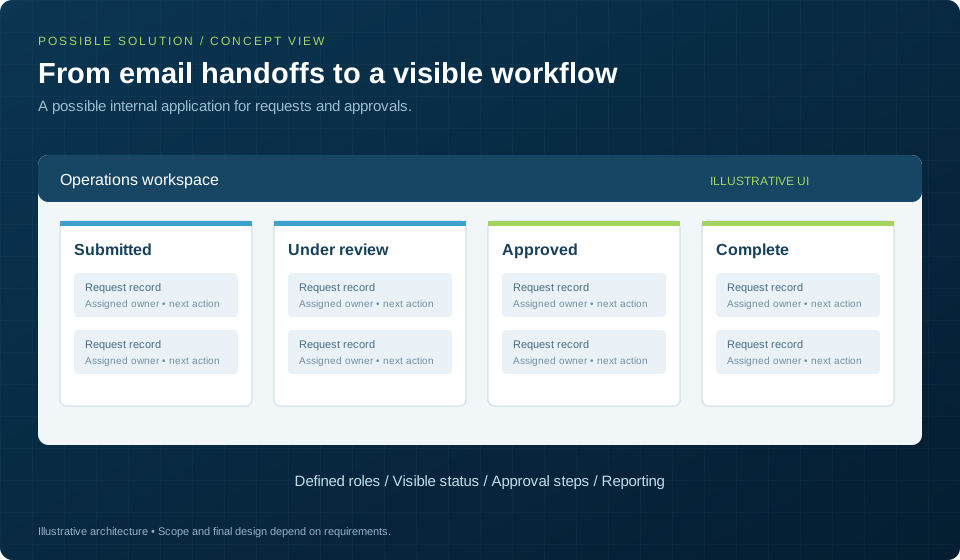
Illustrative possible solution for ai
Make it concrete

Illustrative scenarios to explain the approach; these are not customer case studies or promised results.

Illustrative use case

Manual reporting workflow

Starting point
An operations team combines several spreadsheets to prepare a recurring report.
Approach
Map the source records and approval steps. Prototype a dashboard using representative data and validate the calculations with users.
Potential deliverable
A focused reporting tool scope with known data dependencies.
Illustrative use case

Partner or customer portal

Starting point
Requests and updates move through email without a consistent record of ownership.
Approach
Define user roles, request states, required information, and notifications. Test the key journeys before expanding features.
Potential deliverable
A demonstrable portal workflow and a prioritized development backlog.
How we workExplore
From strategy to execution
01

Define the use case

Map the existing process, user roles, desired outcome, and acceptance criteria.

02

Prototype

Build a focused demonstration with representative workflows and clearly identified sample data.

03

Validate

Gather user feedback, test critical paths, and document gaps and dependencies.

04

Plan deployment

Agree on hosting, integrations, security review, operating ownership, and the next development phase.

What your team can take forward

Scope is agreed before the engagement. The right deliverable should help your team make a decision, coordinate responsibilities, or validate the next step.

Possible engagement outputs

  • Workflow map and role definitions
  • User stories and acceptance criteria
  • Focused prototype with representative data
  • Integration, deployment, and support requirements
Let’s connect
Let’s find your next step

A business challenge.
A smarter way forward.

Start with a conversation about what you need to solve.

Let’s connect