
Solutions / Cloud & infrastructure

Connect your infrastructure to your business strategy.

Plan the network, cloud, and edge requirements that support how your organization actually operates.

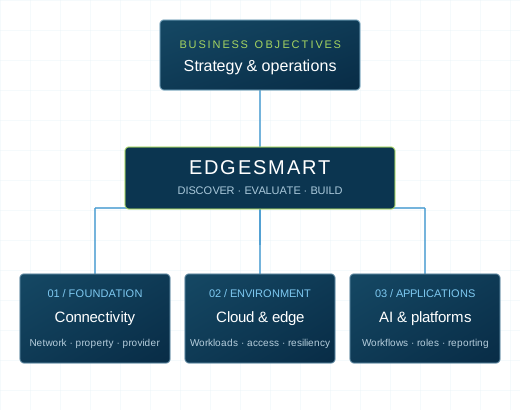
EdgeSmart connects business strategy with connectivity, infrastructure, AI and platforms
A connected view of the technology that runs your business.
CapabilitiesExplore
Detailed service capabilities

Cloud strategy, architecture & modernization

Build a cloud environment around workload requirements, operating responsibilities, and a clear path to growth.

Select a capability to explore the approach and potential deliverables.

01

Cloud readiness & discovery

Assess applications, infrastructure, data, licensing dependencies, access requirements, and current operating processes. Identify workloads that may benefit from modernization and those that should remain in their existing environment.

Potential planning outputs

Application inventory; dependency map; readiness assessment; prioritized opportunities.

02

Public, private & hybrid cloud

Evaluate the fit of public cloud, dedicated infrastructure, private environments, and combinations of these models. Consider data location, application compatibility, latency, internal skills, and the commercial commitments involved.

Potential planning outputs

Deployment-model comparison; workload placement criteria; phased target-state roadmap.

03

Migration planning

Organize workloads into migration waves. Evaluate whether to retain, retire, relocate, rehost, replatform, or redesign each application. Define pilot scope, data transfer needs, test criteria, cutover dependencies, and rollback decisions.

Potential planning outputs

Migration wave plan; prerequisite register; pilot scope; cutover and validation checklist.

04

Cloud networking & connectivity

Review address planning, network segmentation, DNS, routing, remote access, and the connectivity between properties, business sites, data centers, and cloud services. Evaluate private connectivity and internet-based access according to workload needs.

Potential planning outputs

Network requirements; connectivity options; segmentation and access considerations.

05

Compute & application hosting

Compare virtual machines, containers, managed application hosting, and serverless approaches at the requirements level. Match the application lifecycle, scaling needs, integration dependencies, and support model to the hosting approach.

Potential planning outputs

Hosting decision framework; capacity assumptions; deployment dependencies.

06

Storage, databases & data lifecycle

Map data types, access patterns, retention needs, backup requirements, and recovery expectations. Evaluate object, file, and block storage alongside managed database options and the implications of moving data between environments.

Potential planning outputs

Data inventory; retention requirements; storage and database evaluation criteria.

07

Identity, security & governance

Define identity sources, administrative boundaries, least-privilege access, multifactor authentication requirements, and environment separation. Plan logging, policy ownership, encryption requirements, and technical review with the responsible security team.

Potential planning outputs

Access responsibility matrix; governance requirements; review and control checklist.

08

Backup, resilience & disaster recovery

Translate business criticality into recovery time and recovery point requirements. Consider fault isolation, redundancy, backup retention, restore testing, and recovery procedures. Availability and recovery designs need validation against the selected services.

Potential planning outputs

Workload criticality register; recovery requirements; backup and recovery test plan.

09

Cloud economics & cost governance

Assess recurring consumption, licensing, data transfer, storage growth, and support costs. Define tagging, budgets, ownership, and review cadence. Consider rightsizing and commitment options once usage patterns are understood.

Potential planning outputs

Cost model assumptions; budget ownership; usage review and optimization priorities.

10

Operations & modernization roadmap

Connect monitoring, incident escalation, change control, patching responsibilities, release processes, and support ownership. Sequence modernization work so that the operating model evolves alongside the technical environment.

Potential planning outputs

Operating responsibility map; monitoring requirements; phased modernization roadmap.

Possible solutionsExplore
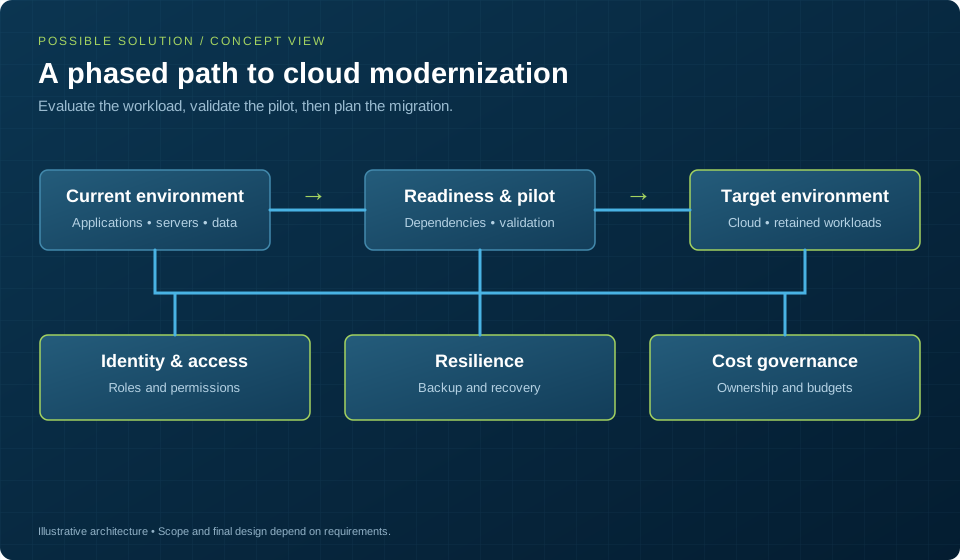
Illustrative possible solution for cloud
Make it concrete

Illustrative scenarios to explain the approach; these are not customer case studies or promised results.

Illustrative use case

Distributed business

Starting point
Multiple locations depend on cloud applications but use different network arrangements.
Approach
Map the sites, users, applications, and connectivity dependencies. Prioritize constraints that could affect critical workflows.
Potential deliverable
A site-by-site roadmap with shared standards and local exceptions.
Illustrative use case

New environment or expansion

Starting point
A team is considering cloud or edge infrastructure before application requirements are clear.
Approach
Define workloads, access, recovery expectations, and operational ownership before requesting provider proposals.
Potential deliverable
A requirements package that makes proposals easier to compare.
How we workExplore
From strategy to execution
01

Assess

Create an inventory of sites, applications, dependencies, and existing infrastructure.

02

Prioritize

Identify constraints, business-critical workloads, and near-term decisions.

03

Design the roadmap

Develop options, sequencing, ownership, and requirements for outside providers.

04

Support the next step

Help translate the roadmap into a proposal review or scoped implementation plan.

What your team can take forward

Scope is agreed before the engagement. The right deliverable should help your team make a decision, coordinate responsibilities, or validate the next step.

Possible engagement outputs

  • Application, site, and dependency inventory
  • Cloud and edge requirements brief
  • Resiliency and recovery questions for technical validation
  • Sequenced roadmap with ownership and decision checkpoints
Let’s connect
Let’s find your next step

A business challenge.
A smarter way forward.

Start with a conversation about what you need to solve.

Let’s connect