Understand before recommending
Start with the existing environment, stakeholders, commercial constraints, and desired business outcome. A useful recommendation needs that context.

EdgeSmart Solutions brings a practical business perspective to connectivity strategy and AI-assisted software development.
EdgeSmart brings approximately 30 years of IT and telecom experience to technology decisions that shape business operations.
EdgeSmart combines that industry background with hands-on, AI-assisted development of business platforms and operational workflows. The focus is making complex choices understandable and turning business requirements into practical next steps.
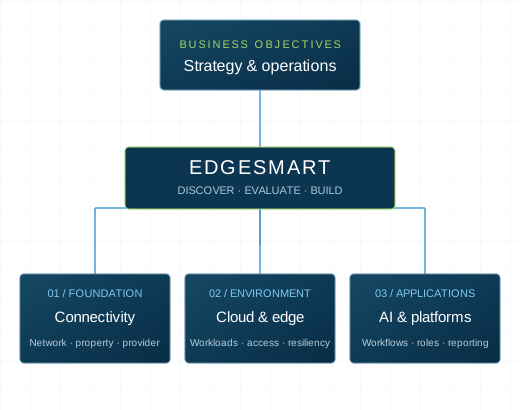
Edge Smart Solutions LLC supports enterprise organizations, business operators, and property portfolios at the intersection of connectivity, cloud infrastructure, and software strategy.
Begin with what the organization needs to achieve, then evaluate the technology that supports it.
Define the scope, expose tradeoffs, and make the next decision easier to understand.
A clear engagement should leave your team better equipped to act.
Start with the existing environment, stakeholders, commercial constraints, and desired business outcome. A useful recommendation needs that context.
Explain what each option changes: operating responsibilities, implementation effort, commercial flexibility, and future requirements.
Make the boundaries clear between consulting, development, vendors, and internal teams. Assign responsibilities instead of allowing assumptions to become gaps.
Use defined acceptance criteria and user feedback to evaluate the next phase. Treat prototypes as a learning tool and production readiness as a separate decision.
An engagement can begin with one decision, a defined project, or an early-stage idea.
For organizations that need direction before committing. Possible outputs include a requirements brief, current-state assessment, options analysis, and prioritized roadmap.
For teams weighing a technical or commercial proposal. Possible outputs include scope gaps, assumptions to validate, comparison criteria, and questions for vendors.
For a workflow or software idea that needs to become concrete. Possible outputs include process maps, role definitions, a demonstrable prototype, and a phased development scope.
For teams preparing to move forward. Possible outputs include implementation dependencies, responsibility maps, decision checkpoints, and an agreed next-step plan.
An engagement should connect executive priorities with the details the delivery team needs.
Frame the decision around operating impact, commercial commitments, responsibilities, and implementation priorities. Create a concise view of options and the unresolved questions that matter.
Document requirements, dependencies, user roles, integration needs, and validation criteria. Distinguish a planning assumption from a requirement that has been confirmed.
Account for the people affected by a change. Connect the proposed solution with access, communications, vendor coordination, training, and ongoing operating ownership.
Define the question to answer, the tasks included, the information needed, and the responsibilities that sit with other teams or providers.
Establish who will review the deliverables, how feedback will be collected, and what constitutes completion of the agreed phase.
Identify external access, provider information, data, engineering review, and stakeholder decisions that could affect progress.
Use the findings to define the next decision. Additional development, implementation, or operating support is scoped explicitly.
Start with a conversation about what you need to solve.